
ERPC Launches Hourly Billing for Solana RPC Products, VPS, and Bare Metal Servers — Try Solana-Optimized Infrastructure from One Hour
ERPC Launches Hourly Billing for Solana RPC Products, VPS, and Bare Metal Servers — Try Solana-Optimized Infrastructure from One Hour
ELSOUL LABO B.V. (Headquarters: Amsterdam, the Netherlands; CEO: Fumitake Kawasaki) and Validators DAO are pleased to announce that ERPC has launched hourly billing plans for Solana RPC products, Solana Geyser gRPC, Solana Shredstream, Direct UDP Stream, VPS, and bare metal servers on the ERPC platform.
The new hourly billing plan is a contract option that lets users use ERPC’s Solana-optimized infrastructure on a one-hour basis. Users can try a configuration for just one hour and continue using the same infrastructure for production operations. PoC work for Solana applications, PMF validation, benchmarking, high-speed prototyping with AI agents, region comparisons, and pre-change verification of existing configurations — phases of work that were previously hard to start under a monthly contract are now easier to run for exactly the time they need.
One-Hour Access to Solana-Optimized Infrastructure — A Third Contract Option Alongside Monthly and Annual
Until today, ERPC offered two contract options: monthly and annual payment. The new hourly billing plan adds a third contract option that allows usage in one-hour increments.
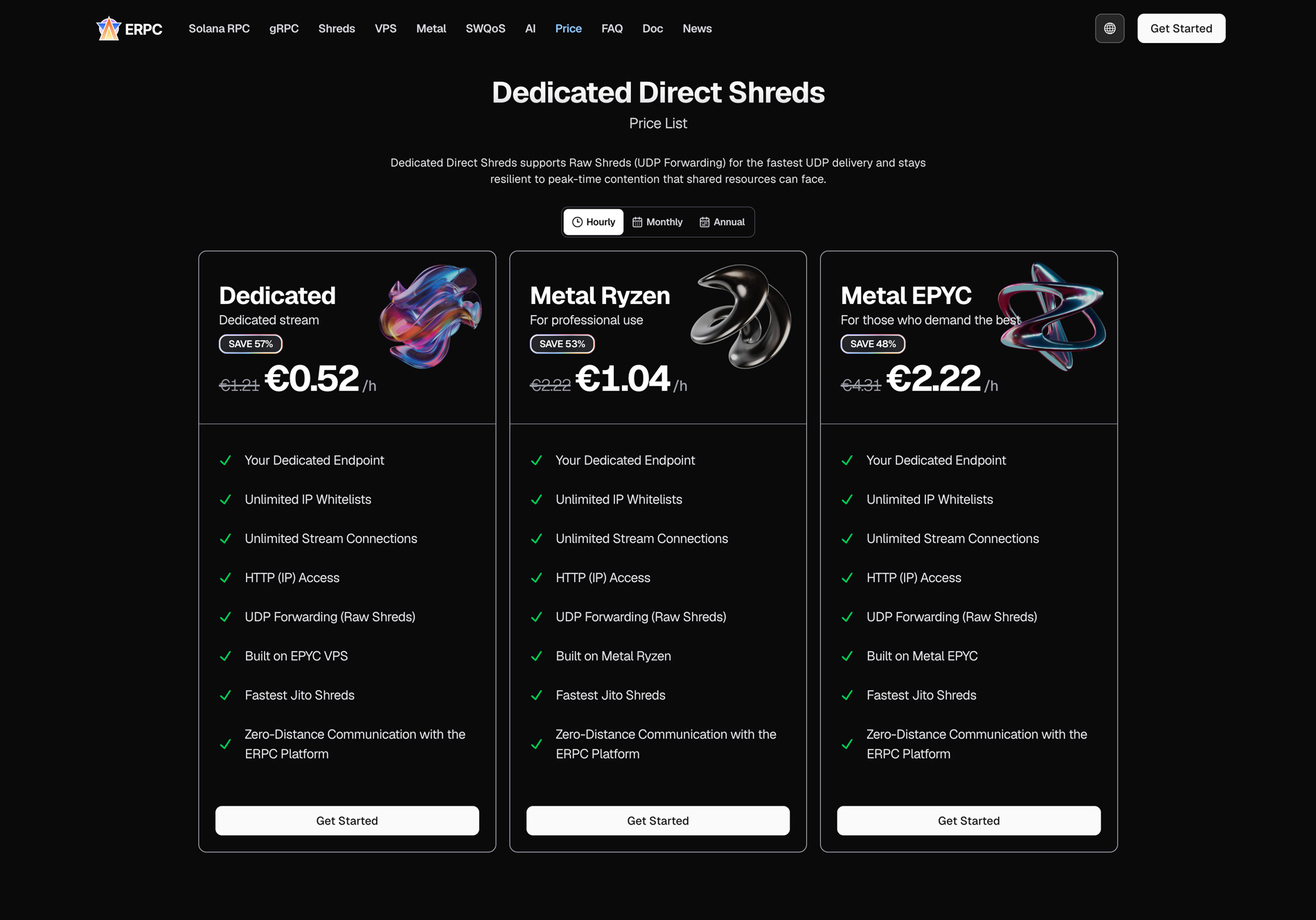
In the ERPC Dashboard, eligible plans display monthly, annual, and hourly pricing side by side, and users can switch between them to compare. It is also possible to start with short-duration hourly usage and switch to monthly or annual payment once configuration and usage volume become clear. This makes it natural to select the contract style that best fits each project phase.
Coverage: All Solana-Optimized Products on the ERPC Platform
Hourly billing applies to ERPC’s full lineup of Solana-optimized infrastructure.
On the Solana RPC side, this includes Solana RPC, WebSocket, Solana Geyser gRPC, Solana Shredstream, and Direct UDP Stream (Raw Shreds). Shared plans, Burst plans, dedicated plans, and Direct Shreds plans across ERPC’s Solana real-time streaming lineup can be tried from one hour, depending on the use case.
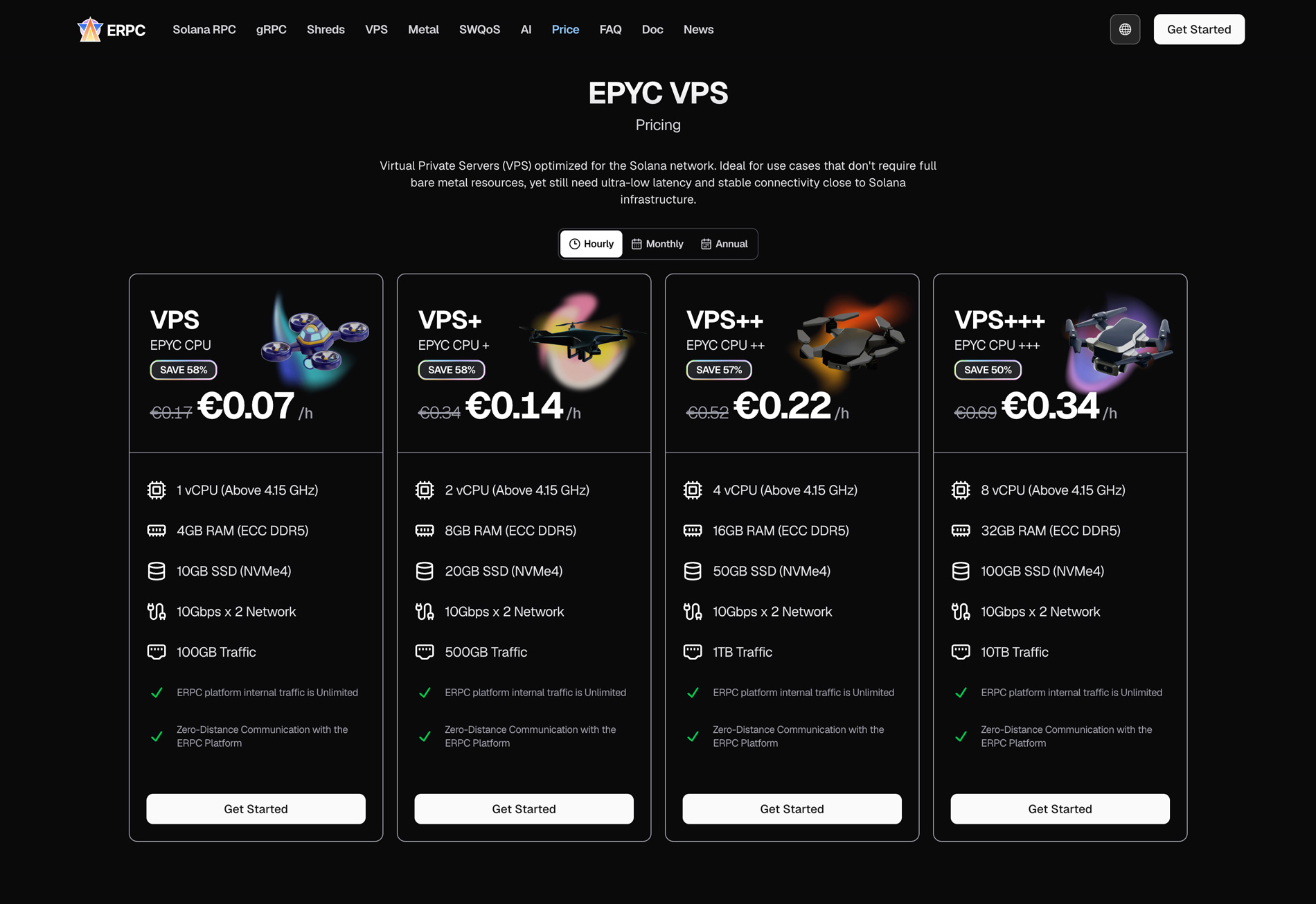
On the server side, the EPYC VPS lineup optimized for the Solana network (VPS / VPS+ / VPS++ / VPS+++) and bare metal servers (Metal Ryzen / Metal EPYC) are available with hourly billing. Lightweight application validation, bot test runs, ad-hoc placement of monitoring processes, spot usage for benchmarking, short-term validation of workloads that need dedicated resources — use cases that were difficult to justify under a monthly contract can now be addressed by simply paying for the hours required.
Bundle plans that combine multiple products are also eligible. Configurations that combine Solana RPC with real-time streams, VPS with streams, or bare metal with streams can be tried first on an hourly basis and then continued under the pricing structure that fits production needs.
EPYC VPS starts at €0.07/hour and Dedicated Direct Shreds starts at €0.52/hour. Full pricing is available in the ERPC Dashboard.
Placed Close to the Solana Network — Speed at the Design Level
What hourly billing makes easy to try is infrastructure that is fast by design for Solana. ERPC places source validators, receiving endpoints, and processing nodes inside premium data centers where Solana validators are densely concentrated, so that distance-related delay is removed at the design level.
Even with optical communication, nothing escapes the physical limit of the speed of light. No matter how fast the network between data centers is, a receiving node placed physically far from the source will always be slower than one placed nearby. ERPC places its resources inside premium data centers where Solana validators are densely concentrated — in particular on the same network as the Epics DAO validator, ranked 3rd in the world overall on the Shinobi Performance Pool — so that distance-related delay is removed at the design level.
The entire ERPC stack is placed in this “close to Solana” location, with regions in Frankfurt (FRA), Amsterdam (AMS), Tokyo (TY), and Singapore (SGP) — with Sydney coming soon. From the moment an hourly-billed resource is launched, users benefit directly from the same design-level advantages: same-network placement next to source validators, route optimization through DoubleZero’s dedicated fiber, and end-to-end traffic that stays inside the ERPC platform’s internal network.
Benchmark numbers come out as a result of these design choices, not the other way around. In equal-condition measurements, ERPC’s Epic Shreds records a 95.82% win rate against a conventional Shredstream baseline and a P99 advantage of about 234ms (measurement methodology). The newly optimized endpoint, the Burst plan, achieves a 99.80% First-Arrival Win Rate against the existing Frankfurt Geyser gRPC endpoint at the global level. These numbers are the result of consistently placing infrastructure close to the Solana network.
Hourly billing makes it possible to measure this design-level advantage in your own environment, without the barrier of a monthly contract.
Verify “Is It Really Fast?” for Yourself, Starting from One Hour
ERPC provides infrastructure that is optimized as a whole — zero-distance communication with the Solana network, validator quality at the source, network routing, server placement, and the performance of processing nodes. While we publish objective benchmarks and measurements, the most reliable way to evaluate the platform for your own workload is to actually try it.
With hourly billing, the questions “Is it really fast?” and “How much difference will this make in my application?” can be answered in your own environment from just one hour, well before deciding on a monthly contract. The First-Arrival Win Rate of Solana Geyser gRPC and Solana Shredstream, the response speed of Solana RPC, receive latency from Direct UDP Stream, and processing throughput on VPS or bare metal servers can all be measured under conditions close to your intended workload.
When combined with ERPC’s open-source benchmark tool, hourly-billed ERPC endpoints can be compared side by side with your current service across First-Arrival Win Rate, P50, P95, P99, ping, firsts, and backfill. ERPC focuses on putting the platform’s claims into a form that users can verify themselves — and hourly billing now extends that same approach to the contract layer.
Solana Geyser gRPC speed comparison documentation:
https://erpc.global/en/doc/geyser-grpc/speed-comparison/
https://erpc.global/en/doc/geyser-grpc/speed-comparison/
Accelerating the PoC and PMF Validation Loop with Hourly Billing
When starting a new Solana application, the first thing teams need is a fast feedback loop: which configuration works, how much speed can be achieved, and whether the idea resonates with users. Until now, even validation work usually required a monthly contract, which sometimes forced infrastructure decisions to be postponed during phases when commitment was not yet justified.
Hourly billing is designed to make this validation loop itself lighter. A pipeline that receives on-chain events through Solana Geyser gRPC, processes them on a VPS, and sends transactions through Solana RPC can be spun up for just a few hours to test the flow. Direct UDP Stream (Raw Shreds) arrival latency can be measured on a bare metal server. Signals detected from Shreds can be fed into bot logic to see whether the intended application is actually viable. All of this can now be iterated in hours, not months.
In early PMF validation, teams typically switch configurations many times while narrowing in on the version of the idea that actually delivers value. Hourly billing matches this rapid “try, observe, try again” pattern by offering a contract style that secures infrastructure only for the time it is needed.
Combined with AI Agents for High-Speed Solana Application Prototyping
ERPC publishes the open-source Solana AI Agent Kit “SLV.” SLV is a tool that lets users handle the deployment and operation of Solana validators, Solana RPC nodes, Solana Geyser gRPC, Solana Shredstream, DoubleZero, and various client applications through natural-language conversation with an AI agent.
Hourly billing is especially well-suited to this kind of AI-agent-based workflow. By delegating implementation to SLV AI agents or to AI coding assistants such as Claude Code, users can build a Shreds receive script, a Geyser gRPC subscription client, a bot prototype, or a draft data pipeline within just a few hours. The generated code can then be pointed immediately at an hourly-billed ERPC endpoint and run in place, allowing real behavior to be observed on the spot.
A cycle of “come up with an idea → ask an AI agent to implement it → run it on hourly-billed Solana-optimized infrastructure” can now be repeated several times in a single day. Infrastructure lead time shrinks to minutes, configuration changes cost just hours, and the overall speed of Solana application prototyping changes meaningfully.
Available Immediately While Inventory Lasts
Hourly billing plans can be activated immediately from the ERPC Dashboard, as long as inventory is available for the selected resource. VPS and bare metal servers are physical resources placed in scarce premium data-center racks, so inventory levels can change over time. Software delivery services such as Solana RPC, Solana Geyser gRPC, Solana Shredstream, and Direct UDP Stream are generally operated without strict inventory constraints.
For plans that are currently sold out on reservation or in waitlist status, hourly billing follows the same allocation order as monthly and annual contracts, with availability provided as inventory is replenished. Current inventory status can be checked in the ERPC Dashboard.
A Third Contract Option Alongside Monthly and Annual — Provided as a Standard Plan
The hourly billing plan is offered as the third contract option alongside monthly and annual payment, and it is provided as a standard, ongoing part of the ERPC platform. It is not a short-term campaign — it is built in as a regular contract option that supports the journey from validation to production and that will be carried forward into future products and plans.
Users can choose the contract style that fits each project phase. Hourly during validation and short-duration spot usage, monthly once configuration and traffic stabilize, and annual when long-term usage is confirmed — and switching between these is simply a matter of choosing within the same plan category in the ERPC Dashboard.
When adding multiple plans, monthly, annual, and hourly options can be mixed in a single cart and processed in one checkout. For example, a production Solana RPC plan can be annual, a real-time stream can be monthly, and a VPS used for evaluation can be hourly — a configuration close to real operational needs can be arranged in a single transaction.
ERPC Platform Coherence — Building a Receive-Process-Send Pipeline on Hourly Plans
On the ERPC platform, Solana RPC, Solana Geyser gRPC, Solana Shredstream, Direct UDP Stream, VPS, bare metal servers, SWQoS, the Pyth-compatible Price API, and Jet Analytics & Indexed RPC can be combined on a single platform. Instead of distributing receive, process, send, and monitoring across distant environments, these functions can be assembled on a platform that is optimized end-to-end for Solana.
With hourly billing, this entire coherent configuration can now be spun up from one hour. A setup that receives data through Solana Geyser gRPC or Solana Shredstream, processes it on a VPS or bare metal server within the same platform via zero-distance communication, and sends transactions through Solana RPC or SWQoS as needed can be experienced first on an hourly basis.
Receiving data quickly loses much of its value if processing and sending downstream are slow. The ability to assemble a coherent pipeline that stays inside the ERPC platform’s internal network, on an hourly basis from short durations, brings a level of flexibility that is new for production-grade Solana infrastructure validation.
Selectable from the ERPC Dashboard
Hourly billing plans are selectable directly from the ERPC Dashboard. On the subscription addition screen, users can choose the target category and switch between monthly, annual, and hourly to compare each price level. Selecting hourly displays the per-hour price, and the order can be placed from there.
The ERPC Dashboard is available in 16 languages — English, Japanese, Simplified Chinese, Traditional Chinese, Russian, Korean, Vietnamese, Thai, Indonesian, Hindi, Turkish, Dutch, German, French, Spanish, and Portuguese. Users can review the hourly billing plan in the language they are most comfortable with and compare it with monthly and annual options while completing the contract.
ERPC Dashboard: https://dashboard.erpc.global/en
AS200261 Solana-Optimized Data Center and Continuous Research and Development
Behind ERPC is ELSOUL LABO’s ongoing research and development of Solana-optimized infrastructure. ELSOUL LABO has been approved for the Dutch government’s WBSO research and development support program for five consecutive years since 2022. The company continues research and development in Solana RPC infrastructure, validator operations, real-time data delivery, AI-agent-based operations and development support, and platform-wide multilingual user experience, and the results are reflected in ERPC, SLV, SLV AI, and the AS200261 Solana-optimized data center.
The Solana-optimized data center operated under the company’s own ASN (AS200261), assigned by RIPE NCC, is also already in operation. By optimizing distance to the Solana network, network routes, server configurations, and operational automation together, ERPC continues to build an environment suited for Solana applications and validator-related workloads.
Hourly billing is a new contract option for trying this Solana-optimized infrastructure on a one-hour basis. Together with monthly and annual payment, it provides a more flexible way to use the ERPC platform across the full path from validation to production operations.
The Resources You Need, in the Amount You Need, for the Duration You Need
ERPC is built on the premise that each Solana application requires a different configuration, and the goal is to make it possible to use the right resources, in the right place, in the right amount. With today’s hourly billing addition, “for the duration you need” is now part of that menu of choices.
With Solana RPC, WebSocket, Geyser gRPC, Shredstream, Direct UDP Stream, VPS, bare metal servers, SWQoS, the Pyth-compatible Price API, Jet Analytics & Indexed RPC, annual / monthly / hourly billing, and Auto top-up all in place, ERPC now supports the full path from validation to production with a contract and product mix that adapts to each project’s phase. ERPC will continue to improve both features and contract options so that Solana developers can use Solana-optimized infrastructure exactly when, and exactly how much, they need.
Contact
For questions about hourly billing plans, eligible plans, Solana RPC, WebSocket, Geyser gRPC, Shredstream, Direct UDP Stream, VPS, bare metal servers, SWQoS, the Pyth-compatible Price API, Jet Analytics & Indexed RPC, API keys, usage, billing, annual / monthly / hourly options, Auto top-up, or configuration consultation, please use the support ticket form in the ERPC Dashboard. Tickets can be submitted in your preferred language.
ERPC Dashboard: https://dashboard.erpc.global/en
ERPC Dashboard Support: https://dashboard.erpc.global/en/user/support
ERPC Official Website: https://erpc.global/en
Validators DAO Official Discord: https://discord.gg/C7ZQSrCkYR
ERPC Dashboard Support: https://dashboard.erpc.global/en/user/support
ERPC Official Website: https://erpc.global/en
Validators DAO Official Discord: https://discord.gg/C7ZQSrCkYR
News