







FAQ - Latency and regions
Questions about billing, the Free plan, payment and 401 or 429 errors are in How to start.
Not specific to a chain
These questions cover how distance, region, server placement, shared or dedicated endpoints and your client's language affect latency.
Q. Do I need to choose a region?
With Edge RPC, you do not need to choose a region. An application that connects to edge.erpc.global is routed automatically to a nearby entry point on the network path.
With Unlimited Endpoints for Solana, Ethereum and Avalanche C-Chain, you choose the region when you order, close to where your trading system or backend runs. Check the available regions in the ERPC Web Dashboard when ordering.
On Solana, no one region suits every strategy, because the leader role rotates across validators on the leader schedule; see the Solana section below.
Q. I'm experiencing high latency. Why?
Are you accessing the endpoint from a physically close location? Distance significantly affects latency. We recommend accessing from servers close to the provided endpoint.
Our network theoretically provides the fastest connections through our Bare-Metal servers and VPS services.
Q. What is the latency like?
Latency varies depending on the measurement method and your specific usage environment. Rather than focusing on exact numerical values, it's crucial to ensure that the latency meets your actual operational requirements.
For Solana, you can measure latency with these open-source tools for TypeScript and Rust.
Q. Why are dedicated endpoints faster?
Shared endpoints are used by multiple customers who share the same resources. As traffic increases, latency tends to occur. Server resources have physical limits, and the amount of work they can handle is finite. When too many requests arrive at the same time, they must be processed sequentially, which results in slower response times.
Although we take various measures to optimize performance even on shared endpoints, with dedicated endpoints you are the sole user of the resource. This means you are completely unaffected by other users, ensuring consistently stable and fast responses.
In addition, dedicated endpoints provide communication options without TLS, such as HTTP. By skipping the TLS handshake, communication becomes even faster compared to HTTPS.
Q. Which plan offers the fastest performance?
Generally, our highest-tier plan provides the fastest performance due to superior CPUs, higher memory capacities, and robust hardware configurations.
We also offer customized solutions if you require even more powerful servers, but our standard plans are designed to deliver optimal price-to-performance ratios.
We are confident in providing world-class performance at every price level. If you find a faster provider within the same price range, please let us know so we can investigate and make improvements.
Q. Latency isn't what I expected.
Performance can vary significantly depending on the programming language used. Typically, language speed comparisons rank as follows:
Rust > Go > TypeScript (JavaScript) > Python
For more detailed comparisons, please see the following resource:
We strongly recommend using Rust if maximum performance is your goal.
 Solana
These answers rely on how Solana works: the leader role rotates across validators on the leader schedule, so validator locations shape the region you pick.
Q. Which region do you recommend?
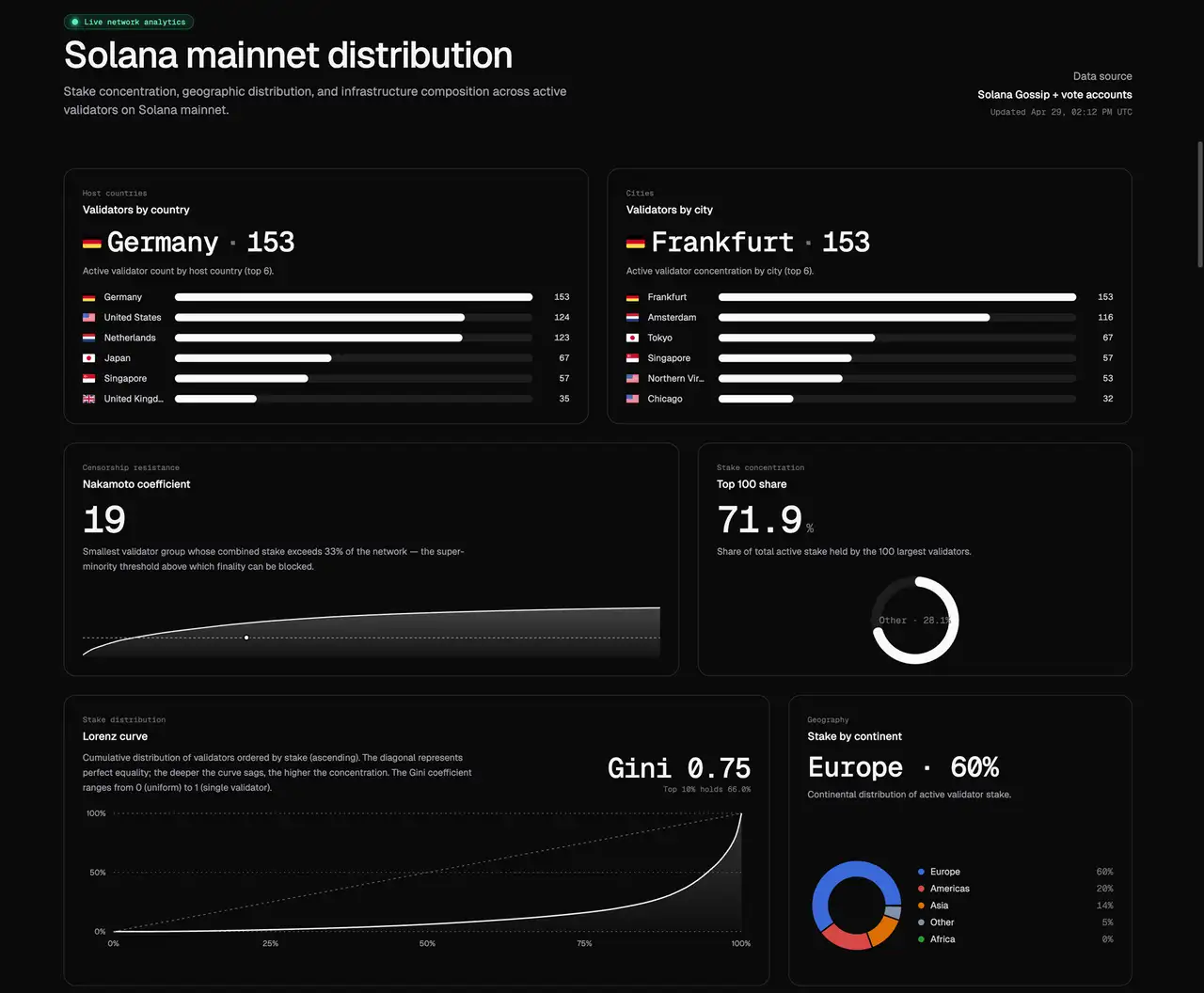
There is no single permanent best region. Solana is global, and the leader role rotates across validators on the leader schedule. Regions with more validators and higher stake see leader slots more often, which can help transactions land faster. The trade-off is that competing traffic also concentrates there, so a less crowded region can sometimes deliver better results depending on your strategy.
As a practical starting point, choose a validator-dense region such as Frankfurt or the US East Coast when steady leader-slot supply matters most, or place yourself near a specific target validator when shortest-path execution is the priority. Use Validators Solutions to understand public Solana network distribution, then use the ERPC Leader Slot API and real measurements to decide whether single-region, dual-region, or global deployment is appropriate.
Q. I need latency of at least ~400ms or better.
To achieve latency within approximately 400ms, consider these essential points:
-
Realistic Understanding of Ping Values: Ping values indicate ideal conditions and do not reflect actual latency in streaming communications, which typically experience around 5 times the ping latency. For example, a ping of 100ms across continents realistically results in about 500ms of latency. Thus, infrastructure must be established within the same region to achieve ~400ms latency.
- Typical Ping Value Reference:
- Same network: ~0.1ms
- Private Network Interconnect (PNI): ~0.2ms
- Same data center: ~0.3ms
- Same city: ~1ms
- Neighboring country: ~5–10ms
- Intercontinental: ~100–300ms
- Typical Ping Value Reference:
-
Avoiding the Pitfall of Average Latency: Solana validators are geographically dispersed globally, and the leader schedule changes randomly with each epoch. Relying on average latency to achieve ~400ms is impractical. Instead, you should precisely track validator schedules in your specific region to identify slots with the lowest latency. To consistently achieve minimal latency, infrastructure across all relevant regions is required. Within the same region, data acquisition can occur in tens of milliseconds, with transmission possible in just a few milliseconds.
-
Tracking the Leader Schedule: Monitor the leader validator schedule for your region using the ERPC Leader Slot API (
getLeaderSlots). It returns the upcoming leader schedule, stake weight for the current epoch, estimated validator geolocations, and reference ping values, so you can identify the lowest-latency slots to target before they arrive. Public map-style data and native RPC APIs are useful for broad network visibility, but they are not precise enough for execution timing. The Leader Slot API fills that gap with the granularity needed for routing and trading decisions.

Solana network data: Validators Solutions
Q. How can I achieve zero-block (zero-slot) trading?
Successfully achieving zero-block (zero-slot) trading requires more sophisticated strategies, as follows:
-
Identifying Opportunity Zones: Solana validators are distributed globally, and it is physically impossible to achieve optimal latency for every slot. Therefore, monitor validator leader schedules in the region where your infrastructure is located and identify the most favorable opportunity zones. Deploying infrastructure across multiple regions can also be advantageous. For example, Frankfurt is a key region due to its high validator density, resulting in more frequent leader selection and greater trading opportunities.Use the ERPC Leader Slot API (
getLeaderSlots) to look up the upcoming leader schedule, stake weight for the current epoch, estimated validator geolocation data, and reference ping values with far greater precision than public map-style data sources or native RPC APIs. This lets you map opportunity zones before the slots arrive and execute near-zero-latency trades. -
Implementing Dedicated Nodes: If you struggle to compete, consider deploying dedicated nodes. Shared nodes experience latency due to traffic from other users, and thus are not recommended. Furthermore, placing your dedicated node within the same network as your application significantly reduces network latency and optimizes performance.
Q. Which is the fastest: WebSockets, gRPC, or Shreds?
Feedback from many customers is quite consistent, and the performance order is as follows:
Shreds > gRPC > WebSockets
If you discover different results or conditions, please let us know.
Q. Is this RPC (gRPC, Shreds) faster than others?
We build for speed at every tier, and we're glad to have that measured side-by-side with any other provider. Results can shift with region, whether you're on a shared or dedicated endpoint, the protocol you use (WebSockets, gRPC, or Shreds), and the programming language your client runs in.
If you find our service slower, please let us know the specific conditions and competitors you've compared it against through the ERPC Web Dashboard. We will identify the cause and improve the speed further.